
| 2025 №04 (06) |
DOI of Article 10.37434/sem2025.04.07 |
2025 №04 (08) |
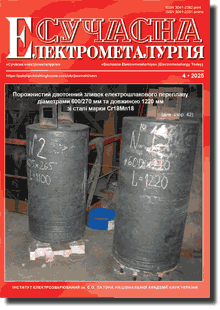
"Suchasna Elektrometallurgiya" (Electrometallurgy Today), 2025, #4, 43-48 pages
Investigation of the processes of diffusion and their influence on electrical resistivit y of graphitized wick electrodes applied in industrial steelmaking arc furnaces
O.G. Bogachenko1, D.D. Mishchenko1, I.O. Goncharov1, I.O. Neilo1, S.G. Kiiko2, I.M. Logozinskyi2, K.M. Gorban2, A.G. Fedkov2
1E.O. Paton Electric Welding Institute of the NAS of Ukraine 11 Kazymyr Malevych Str., 03150, Kyiv, Ukraine. E-mail: stemet@ukr.net2PJSC «Electrometallurgical Plant «Dniprospetsstal». 81 Pivdenne Highway, 69008, Zaporizhzhzya, Ukraine. E-mail: info@dss.com.ua
Abstract
It is noted that during application of composite (wick) electrodes in industrial steelmaking arc furnaces, diffusion processes run in the wick-electrode system, which determine the properties of the graphitized wick electrode and of the wick proper, as well as the electric arc parameters. An investigation was performed of the diffusion processes and their influence on the electrical resistivity of the body of graphitized wick electrode of EG grade with the initial diameter of 350 mm, which has passed the full cycle of heating in DSP PS-12 furnace with subsequent cooling to ambient temperature and holding for 1.2·105 h. It was found that active diffusion of all the main components of the wick (K, Ba, Cu, Cr, Ti ) into the electrode body occurs in the wick-electrode system. The higher the content of copper, barium, titanium and other wick components in the specimen, the lower is its electrical resistivity, and vice versa. Diffusion of the wick components in the wick-electrode system results in 35...40 % lower electrical resistivity of the wick electrode than that of the initial monolithic electrode. 8 Ref., 3 Tabl., 5 Fig.
Keywords: steelmaking arc furnaces, graphitized wick electrode, diffusion, electrical resistivity
Received: 30.07.2025
Received in revised form: 25.09.2025
Accepted: 12.11.2025
References
1. Bogachenko, A.G., Mishchenko, D.D., Braginets, V.I. et al. (2016) Saving of electric power at the arc steel melting furnaces of direct current with graphitized cored electrodes. Sovremennaya Elektrometallurgiya, 1, 58-64 [in Russian]. https://doi.org/10.15407/sem2016.01.092. Paton, B.E., Bogachenko, O.G., Kyiko, S.G. et al. (2021) Experience of application of graphitized wick electrodes in industrial steel-making ac furnace. Suchasna Elektrometalurhiya, 1, 48-53 [in Ukrainian]. https://doi.org/10.37434/sem2021.01.06
3. Bogachenko, O.G., Chernyakov, A.V., Goncharov, I.O. et al. (2024) Application of graphitized cored electrodes in 50 ton steel melting ac arc furnace of DSV-50 type. Suchasna Elektrometalurhiya, 1, 32-39 [in Ukrainian]. https://doi.org/10.37434/sem2024.01.04
4. Bogachenko, O.G., Mishchenko, D.D., Goncharov, I.O. et al. (2024) Composite (cored) graphitized electrodes for industrial DC and AC steel-melting furnaces. Suchasna Elektrometalurhiya, 2, 35-45 [in Ukrainian]. https://doi.org/10.37434/sem2024.02.06
5. Vodennikov, S.A. (2009) Scientific-technological fundamentals of formation of composite coatings from ion melts for predictable provision of functional properties of porous materials: Syn. of Thesis for Dr. of Techn. Sci. Degree. Zaporizhzhia, ZhNTU [in Ukrainian].
6. Grudnitskiy, O.M., Iskhakov, R.A-R., Korobov, V.K. (2011) Ways of reduction of specific consumption of graphitized electrodes in electric arc furnaces. Litio i Metallurgiya, 1, 100-101 [in Russian].
7. Makhnenko, O.V., Kostenevich, O.S., Saprykina, G.Yu. et al. (2024) Mathematical modeling of the processes of component diffusion in a wick-graphite electrode system in industrial DC arc steel melting furnace of DSP PS-12 type. Suchasna Elektrometalurhiya, 4, 24-28 [in Ukrainian]. https://doi.org/10.37434/sem2024.04.04
8. Fialkov, A.S.(1997) Carbon. Interlayer compounds and composites on its base. Moscow, Aspekt Press [in Russian].
This article is licensed under a Creative Commons Attribution-NonCommercial-NoDerivatives 4.0 International License.
Suggested Citation
O.G. Bogachenko, D.D. Mishchenko, I.O. Goncharov, I.O. Neilo, S.G. Kiiko, I.M. Logozinskyi, K.M. Gorban, A.G. Fedkov (2025) Investigation of the processes of diffusion and their influence on electrical resistivit y of graphitized wick electrodes applied in industrial steelmaking arc furnaces. Electrometallurgy Today, 04, 43-48. https://doi.org/10.37434/sem2025.04.07Advertising in this issue:


