

| 2026 №10 (03) | 2026 №10 (05) |
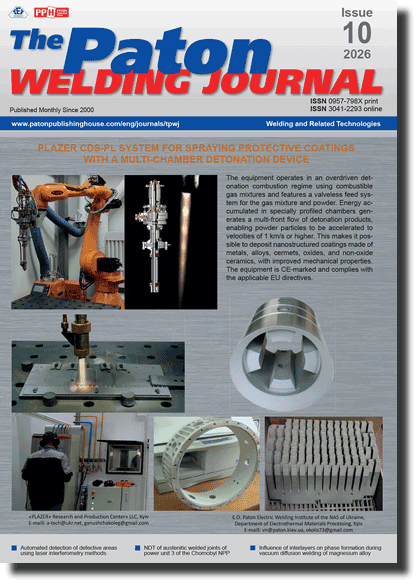
The Paton Welding Journal, 2026, #10, 39-52 pages
Influence of interlayers on phase formation during vacuum diffusion welding of magnesium alloy MA2-1
V.A. Kostin , O.L. Puzryn, Yu.V. Falchenko, L.V. Petrushynets, A.G. Poklyatsky
E.O. Paton Electric Welding Institute of the NASU.
11 Kazymyr Malevych Str., 03150, Kyiv, Ukraine.
E-mail: procesor1@ukr.net
Abstract
Vacuum diffusion welding of MA2-1 magnesium alloy using continuous and perforated layers of Zn, Cu, Ni, and Ti under the action of forming dies is investigated in the paper. It is shown that continuous interlayers limit the localization of plastic deformation, contribute to the preservation of the MgO oxide film and the formation of flat pores, which reduces the strength of the joints to ~50 % of that of the base metal. Perforated interlayers provide a local reduction in deformation resistance, a directed flow of magnesium into the holes, and mechanical crushing of oxides, forming nascent metal bonds and a fine crystalline structure on the joint interface. It was found that in systems with Cu and Ni, Mg2Cu and Mg2Ni hard intermetallics with high microhardness are formed, causing stress concentration, appearance of pore chains and a tendency to brittle fracture. In the Mg–Ti pair, the intermetallics are not formed, diffusion is limited, and titanium acts as an effective barrier, ensuring high ductility of the weld and a bending angle of up to 180°. The optimal combination of forming dies and perforated titanium interlayers allows reducing the temperature and welding time without thermal degradation of the alloy, increasing the strength of the joints to 143 MPa and ensuring their high reliability for aviation and space applications.
Keywords: vacuum diffusion welding, magnesium alloy MA2-1, intermediate layers, forming dies, phase analysis, microstructure, intermetallic compounds
Received: 08.02.2026
Received in revised form: 20.05.2026
Accepted: 29.10.2026
References
1. Falchenko, Y.V., Petrushynets, L.V., Fedorchuk, V.E. et al. (2023) Diffusion welding of magnesium alloy MA2-1 through a zinc interlayer. The Paton Welding J., 9, 38–42. DOI: https://doi.org/10.37434/tpwj2023.09.062. Falchenko, Iu.V., Petrushynets, L.V., Fedorchuk, V.E. et al. (2024) Diffusion welding of magnesium alloy MA2-1 through the intermediate layer of titanium or nickel. Automatic Welding, 5, 55–59 [in Ukrainian]. DOI: https://doi.org/10.37434/as2024.05.07
3. Fronczek, D.M., Chulist, R., Litynska-Dobrzynska, L. et al. (2017) Microstructure and kinetics of intermetallic phase growth of three-layered A1050/AZ31/A1050 clads prepared by explosive welding combined with subsequent annealing. Materials & Design, 130, 120–130. DOI: https://doi.org/10.1016/j.matdes.2017.05.051
4. Jafarian, M., Paidar, M., Jafarian, M. (2022) The Comparison of microstructure and mechanical properties of diffusion joints of 5754, 6061, and 7039 aluminum alloys to AZ31 magnesium alloy. J. Adv. Mater. Eng., 35(1), 11–21. DOI: https://doi.org/10.18869/acadpub.jame.35.1.11
5. Vatnalmath, M., Auradi, V., Vedashantha Murthy, B. et al. (2025) Vacuum diffusion bonding of dissimilar metal alloys AA2219 and Ti–6Al–4V: Influence of bonding pressure on microstructure and mechanical properties of the bonding joint. IJMSE, 22(2), 78–91. DOI: https://doi.org/10.22068/ijmse.3776
6. Liu, L., Ren, D., Liu, F. (2014) A review of dissimilar welding techniques for magnesium alloys to aluminum alloys. Materials, 7(5), 3735–3757. DOI: https://doi.org/10.3390/ma7053735
7. Chen, H., Zhu, Z., Zhu, Y. et al. (2023) Solid-state welding of aluminum to magnesium alloys: A review. Metals, 13(8), 1410. DOI: https://doi.org/10.3390/met13081410
8. Gang Chen, Tianbao Tan, Yangyang Guo at al. (2023) An investigation on diffusion bonding of Mg/Al dissimilar metals using Zn–Bi alloy as interlayer. Materials Letters, 349, 134827. DOI: https://doi.org/10.1016/j.matlet.2023.134827
9. Manafi, S., Azizi, A. (2021) Experimental and numerical evaluation of diffusion welding of 7075 aluminum and AZ31 magnesium alloys. Advanced Ceramics Progress, 7(1), 25–34. DOI: https://doi.org/10.30501/acp.2021.257290.1051
10. Lyamin, Ya.V., Musin, R.A. (1995) Deformability of perforated interlayers in diffusion bonding. Welding Inter., 9, 228– 230. DOI: https://doi.org/10.1080/09507119509548785
11. Dietrich, D., Nickel, D., Krause, M. et al. (2011) Formation of intermetallic phases in diffusion-welded joints of aluminium and magnesium alloys. J. Mater. Sci., 46, 357–364. DOI: https://doi.org/10.1007/s10853-010-4841-5
12. Khan, S., Ali, Z., Khadija, K., Junaid, M. (2024) Mechanical and microstructural characterization of diffusion-bonded copper-nickel joint interface. Advanced Materials Research, 1179, 147–155. DOI: https://doi.org/10.4028/p-k8wuuo
13. Mishra, R.S., Sumit Jain, Preety Rani (2022) Microstructure and mechanical properties of the dissimilar welded joint of aluminum and magnesium alloys — A review. Inter. J. of Research in Engineering and Innovation, 6(4), 252–258. DOI: https://doi.org/10.36037/IJREI.2022.6407
14. (2011) Welding and joining of magnesium alloys. Magnesium alloys — design, processing and properties. Ed. by F. Czerwinski. InTech. DOI: https://doi.org/10.5772/13947
15. Ho-Sung Lee (2021) 10 — Diffusion bonding of metal alloys in aerospace and other applications. In: Welding and joining of aerospace materials. Second Ed. Ed. by Mahesh Chaturvedi. Woodhead Publishing Series in Welding and Other Joining Technologies, 305–327. DOI: https://doi.org/10.1016/B978-0-12-819140-8.00010-9
16. Tianle Li, Yiwen Lei, Lezong Chen et al. (2025) Advances in mechanism and application of diffusion bonding of titanium alloys. J. of Materials Processing Technology, 337, 118736. DOI: https://doi.org/10.1016/j.jmatprotec.2025.118736
17. Borrisutthekul, R., Miyashita, Y., Mutoh, Y. (2005) Dissimilar material laser welding between magnesium alloy AZ31B and aluminum alloy A5052-O. Sci. and Technol. of Advanced Materials, 6(2), 199–204. DOI: https://doi.org/10.1016/j. stam.2004.11.014 18. Łyczkowska, K., Miara, D., Rams, B. et al. (2023) The influence of MSR-B Mg alloy surface preparation on bonding properties. Materials, 16(10), 3887. DOI: https://doi.org/10.3390/ma16103887
19. Wenbo Wang, Wensheng Liu, Lun Yang, Yunzhu Ma (2025) Solid-liquid composite diffusion in Al/Mg bimetallic joints with the Ni/Cu interlayer. J. of Materials Research and Technology, 37, 3315–3323. DOI: https://doi.org/10.1016/j.jmrt.2025.06.235
20. Yin, F., Liu, C., Zhang, Y. et al. (2018) Effect of Ni interlayer on characteristics of diffusion bonded Mg/Al joints. Mater. Sci. and Technol., 34(9), 1104–1111. DOI: https://doi.org/10.1080/02670836.2018.1424382
21. Pai Peng, Wen Wang, Ting Zhang et al. (2022) Effects of interlayer metal on microstructures and mechanical properties of friction stir lap welded dissimilar joints of magnesium and aluminum alloys. J. of Mater. Process. Technol., 299, 117362. DOI: https://doi.org/10.1016/j.jmatprotec.2021.117362
22. Cooke, K. (2020) Kinetics of joint formation during diffusion induced solid-state bonding of titanium and magnesium alloys. In: 18th LACCEI Inter. Multi-Conf. for Engineering, Education, and Technology: Engineering, Integration, and Alliances for a Sustainable Development. Hemispheric Cooperation for Competitiveness and Prosperity on a Knowledge- Based Economy, July 27–31, 2020. DOI: http://dx.doi.org/10.18687/LACCEI2020.1.1.287
23. Falchenko, Y.V., Petrushynets, L.V. (2022) Modern technological methods of pressure welding of magnesium alloys (Review). The Paton Welding J., 6, 29–40. DOI: https://doi.org/10.37434/tpwj2022.06.05
24. Habisch, S., Böhme, M., Peter, S. et al. (2018) The effect of interlayer materials on the joint properties of diffusion-bonded aluminium and magnesium. Metals, 8(2), 138. DOI: https://doi.org/10.3390/met8020138 25. Ustinov, A.I., Falchenko, Iu.V., Melny chenko, T.V. et al. (2017) Diffusion welding through vacuum-deposited porous interlayers. J. of Mater. Process. Technol., 247, 268–279. DOI: https://doi.org/10.1016/j.jmatprotec.2017.04.029
26. Luo, A.A. (2013) Magnesium casting technology for structural applications. J. of Magnesium and Alloys, 1(1), 2–22. DOI: https://doi.org/10.1016/j.jma.2013.02.002
27. Mordike, B.L., Ebert, T. (2001) Magnesium: Properties — applications — potential. Mater. Sci. Eng.: A, 302(1), 37–45. DOI: https://doi.org/10.1016/S0921-5093(00)01351-4
28. Kostin, V.A., Falchenko, Yu.V., Puzrin, A.L., Makhnenko, A.O. (2023) Production, properties and prospects of application of modern magnesium alloys. Electrometallurgy Today, 1, 43–52 [in Ukrainian]. DOI: https://doi.org/10.37434/sem2023.01.06
29. Mahendran, G., Babu, S., Balasubramanian, V. (2010) Analyzing the effect of diffusion bonding process parameters on bond characteristics of Mg‒Al dissimilar joints. J. of Mater. Eng. and Perform, 19, 657–665. DOI: https://doi.org/10.1007/s11665-009-9531-6
30. Moghaddam, N.T., Rabiezadeh, A., Khosravifard, A. et al. (2023) Welding of Al–Mg alloy: Solid-state vs. fusion welding techniques. Iran. J. Sci. Technol. Trans. Mech. Eng., 47, 673–686. DOI: https://doi.org/10.1007/s40997-022-00536-7
31. Kostin, V. et al. (2021) Influence of adhesive bond line thickness on joint strength of composite aircraft structures. J. Phys.: Conf. Ser., 1925, 012070 DOI: https://doi.org/10.1088/1742- 6596/1925/1/012070
32. Melnychenko, T.V., Samofalov, O.V., Ustinov, A.I (2024) Effect of Ti/Cu and Ti/Ni multilayer foils on microstructure and mechanical properties of diffusion bonded Ti6Al4V alloy joints. In: Proc. of VII Inter. Conf. on Welding and Related Technologies, 7–10 October 2024, Yaremche, Ukraine. Kyiv, International Association “Welding”.
33. Petrushynets, L.V., Fedorchuk, V.Y., Mikhailov, L.V. et al. (2025) Investigation of the microstructure of aluminum and magnesium joints during diffusion welding. Mater. Sci., 60, 470–476. DOI: https://doi.org/10.1007/s11003-025-00907-w
34. Mahendran, G., Balasubramanian, V., Senthilvelan, T. (2010) Influences of diffusion bonding process parameters on bond characteristics of Mg‒Cu dissimilar joints. Transact. of Nonferrous Metals Society of China, 20(6), 997–1005. DOI: https://doi.org/10.1016/S1003-6326(09)60248-X
35. Xin-jian Yuan, Guang-min Sheng, Jun Luo, Jia Li (2013) Microstructural characteristics of joint region during diffusion- brazing of magnesium alloy and stainless steel using pure copper interlayer. Transact. of Nonferrous Metals Society of China, 23(3), 599–604. DOI: https://doi.org/10.1016/S1003-6326(13)62505-4
36. Dai, J., Jiang, B., Zhang, J. et al. (2015) Diffusion kinetics in Mg‒Cu binary system. J. Phase Equilib. Diffus., 36, 613–619. DOI: https://doi.org/10.1007/s11669-015-0417-z
37. Zhang, Jian, Qiang Luo, Qiang Shen, Liangmeng Zhang (2014) Diffusion mechanism and kinetics of diffusion bonded Mg/Ni/Al joint. Key Engineering Materials, 616, 286–290. DOI: https://doi.org/10.4028/www.scientific.net/KEM.616.286
38. Cheng, S.L., Chen, Y.Y., Lee, S.W., Hsu, H.F. (2009) Formation of Mg2Ni alloy layers and kinetic studies in the binary Mg–Ni system. Thin Solid Films, 517(17), 4745–4748. DOI: https://doi.org/10.1016/j.tsf.2009.03.011
39. Walker L., Fink, C., Hilla, C., Ying Lu (2023) Peculiar roles of nickel diffusion in intermetallic compound formation at the dissimilar metal interface of magnesium to steel spot welds. Materials & Design, 230(3), 111980. DOI: https://doi.org/10.1016/j.matdes.2023.111980
40. Fanjin Yao, Guoqiang You, Lei Wang et al. (2022) Design, fabrication, microstructure, and mechanical properties of interlayer- free vacuum diffusion bonding Mg/Ti composites. Vacuum, 199, 110947. DOI: https://doi.org/10.1016/j.vacuum.2022.110947
41. Kvasnytskyi, V.V., Matvienko, M.V., Buturlia, Y.A. et al. (2019) Stressed-deformed condition in diffusion welding and decking of cylindrical knots with a soft interior in conditions of force and thermal stress within the limits of elasticity. Visnyk Odeskoho Natsionalnoho Morskoho Universytetu, 1, 126–139 [in Ukrainian]. http://nbuv.gov.ua/UJRN/Vonmu_2019_1_13
42. Kvasnytskyi, V.V., Matviienko, M.V., Buturlya, E.A. et al. (2019) Stress-strain state of welded and brazed assemblies of dissimilar materials with soft interlayer at temperature-force loading. The Paton Welding J., 8, 2–6. DOI: https://doi.org/10.15407/tpwj2019.08.01
43. Lobanov, L.M., Yermolayev, G.V., Kvasnitsky, V.V. et al. (2016) Stresses and deformations in welding and soldering: Textbook H 27. Ed. by L.M. Lobanov. Mykolaiv, NUK [in Ukrainian].
44. Bolotov, M.G., Prybytko, I.O., Nahorna, I.V. (2020) Glow discharge as a heating source for the processes of joining of different materials (Review). Techn. Sci. Technol., 2(20), 022–036 [in Ukrainian]. DOI: https://doi.org/10.25140/2411-5363-2020-2(20)-22-36
45. Novomlynets, O.O., Yushchenko, S.M., Oleksiienko, S.V. (2021) New technology of pressure welding of aluminium with copper through interlayer. Techn. Sci. Technol., 4(18), 009–017 [in Ukrainian]. DOI: https://tst.stu.cn.ua/article/view/200335
Suggested Citation
V.A. Kostin, O.L. Puzryn, Yu.V. Falchenko, L.V. Petrushynets, A.G. Poklyatsky (2026) Influence of interlayers on phase formation during vacuum diffusion welding of magnesium alloy MA2-1. The Paton Welding J., 10, 39-52.To order the electronic version of the paper:
V.A. Kostin, O.L. Puzryn, Yu.V. Falchenko, L.V. Petrushynets, A.G. PoklyatskyInfluence of interlayers on phase formation during vacuum diffusion welding of magnesium alloy MA2-1
The Paton Welding Journal №10 2026 p.39-52
The cost of article (pdf): 28 $, 24 €, 600 UAH (1 copy. )
fill in the form below:
The cost of subscription/purchase order journals or individual articles
| Journal/Currency | Annual Set | 1 issue printed |
1 issue |
one article |
| TPWJ/USD | 384 $ | 32 $ | 28 $ | 28 $ |
| TPWJ/EUR | 348 € | 29 € | 24 € | 24 € |
| TPWJ/UAH | 7200 UAH | 600 UAH | 600 UAH | 600 UAH |
| TDNK/UAH | 1680 UAH | 420 UAH | free access | free access |
| TDNK/USD | 128 $ | 32 $ | free access | free access |
| TDNK/EUR | 116 € | 29 € | free access | free access |
TPWJ = «PATON WELDING JOURNAL» - 12 issues per year;
TDNK = «Technical Diagnostics and Non-Destructive Testing» - 4 issues per year;
SEM = «Electrometallurgy Today» - 4 issues per year, operates under a diamond open access model, providing free and unrestricted access;
AS = «Automatic Welding» - 6 issues per year, operates under a diamond open access model, providing free and unrestricted access/