


| 2025 №05 (07) |
DOI of Article 10.37434/as2025.05.08 |
2025 №05 (09) |
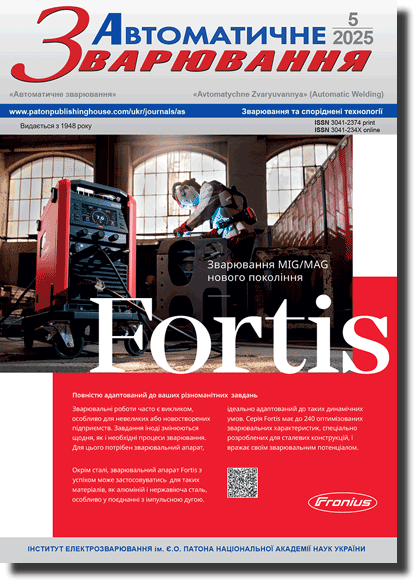
"Avtomatychne Zvaryuvannya" (Automatic Welding), #5, 2025, pp. 68-74
Automation of the manufacturing process of a drilling tool fragment using additive deposition method
A.S. Novodranov, O.M. Savytskyi
E.O. Paton Electric Welding Institute of the NAS of Ukraine 11 Kazymyr Malevych Str., 03150, Kyiv, Ukraine. E-mail: artur19940731@gmail.comNowadays, 3D printing technology is actively developing and is used in the manufacture of parts for various industries. This paper outlines the advantages, limitations, and characteristics of surfacing complex-shaped parts using pulsed arc and constant power arc methods. Four robotic surfacing approaches were investigated, including three variations of the pulsed arc mode, which provided high-quality deposited metal and a fine-grained structure. The deposited metal was tested for impact toughness, and all samples demonstrated high impact toughness regardless of the surfacing method. However, the additive surfacing of metal parts may lead to surface defects such as pores and cracks in the deposited layers. The use of a robotic system based on an anthropomorphic robot with an integrated machine vision system enhances both the quality and productivity of the surfacing process. The analysis of macro- and microstructures of the deposited metal specimens confirmed the effectiveness of the defect detection system. As a result of the study, an experimental drilling auger was successfully manufactured via robotic surfacing using a constant power arc. 13 Ref., 4 Tabl., 6 Fig.
Keywords: 3D technology, WAAM deposition, anthropomorphic robot, machine vision system, defect recognition, constant power arc, pulsed arc
Received: 25.04.2025
Received in revised form: 19.06.2025
Accepted: 08.10.2025
References
1. Sorokin, V.G. (1989) Data base of steels and alloys. Moscow, Mashinostroenie [in Russian].2. Paton, B.E. (1974) Technology of the fusion electric welding. Moscow, Mashinostroenie [in Russian].
3. Sterenbogen, J.A., Petrov, P.F. (1979) The influence of the crystallization temperature range on the tendency of steels to form crystallization cracks during welding. Avtomaticheskaya Svarka, 7, 10-13 [in Russian].
4. Nazarchuk, A.T. (1997) The influence of portion-discrete formation of seams on the thermal cycle of arc fusion welding. Avtomaticheskaya Svarka, 5, 13-17 [in Russian].
5. Nazarchuk, A.T. (2000) Improvement of process of consumable electrode welding with an intermittent arc. The Paton Welding J., 7, 28-31.
6. Nazarchuk, A.T., Snisar, V.V., Demchenko, E.L. (2003) Portioned heat input as a method to control structure of the weld and HAZ metal. The Paton Welding J., 12, 34-37.
7. ASTM-International, ASTM Standard F2792- 12 (2012) Standard Terminology for Additive Manufacturing Technologies.
8. Anuj V. Dongaonkar, Rajesh M. Metkar (2018) Reconstruction of Damaged Parts by Integration Reverse Engineering (RE) and Rapid Prototyping (RP). 3D Printing and Additive Manufacturing Technologies, 159-171. https://doi.org/10.1007/978-981-13-0305-0_14
9. Shah, A., Aliyev, R., Zeidler, H., Krinke, S. (2023) A review of the recent developments and challenges in wire arc additive manufacturing (WAAM) process. J. Manuf. Mater. Process, 7, 97. https://doi.org/10.3390/jmmp7030097
10. Rodrigues, T.A., Duarte, V., Miranda, R.M., Santos, T.G., Oliveira, J.P. (2019) Current status and perspectives on wire and arc additive manufacturing (WAAM). Materials, 12, 1121. https://doi.org/10.3390/ma12071121
11. Shapovalov, E.V., Novodranov, A.S., Vashchenko, V.M., Savytskyi, O.M., Klishchar, F.S. (2024) Robotic complex for multilayer surfacing by periodic arc and control of surface defects of the deposited metal. Avtomatychne Zvariuvannya, 6, 43-50 [in Ukrainian]. https://doi.org/10.37434/as2024.06.07
12. Shapovalov, E.V., Novodranov, A.S., Vashchenko, V.M., Savytskyi, O.M., Topchev, D.D. (2025) Specifications of using intermittent action and constant power arcs in 3D welding technologies. Avtomatychne Zvariuvannya, 2, 43-50 [in Ukrainian]. https://doi.org/10.37434/as2025.02.06
13. Shapovalov, E.V., Novodranov, A.S. (2025) Applying neural network technologies for quality control in robotic surfacing. In: Proc. of the VIIth Intern. Conf. on Welding and Related Technologies, Yaremche, Ukraine, 7-10 October 2024, 154- 157. https://doi.org/10.1201/9781003518518-31
Advertising in this issue:
To order the electronic version of the paper:
A.S. Novodranov, O.M. SavytskyiAutomation of the manufacturing process of a drilling tool fragment using additive deposition method
Automatic Welding №05 2025 p.68-74
The cost of article (pdf): 28 $, 24 €, 420 UAH (1 copy. )
fill in the form below:
The cost of subscription/purchase order journals or individual articles
| Journal/Currency | Annual Set | 1 issue printed |
1 issue |
one article |
| TPWJ/USD | 384 $ | 32 $ | 28 $ | 28 $ |
| TPWJ/EUR | 348 € | 29 € | 24 € | 24 € |
| TPWJ/UAH | 7200 UAH | 600 UAH | 600 UAH | 600 UAH |
| AS/UAH | 2520 UAH | 420 UAH | 420 UAH | 420 UAH |
| AS/USD | 192 $ | 32 $ | 28 $ | 28 $ |
| AS/EUR | 174 € | 29 € | 24 € | 24 € |
| SEM/UAH | 1680 UAH | 420 UAH | 420 UAH | 420 UAH |
| SEM/USD | 128 $ | 32 $ | 28 $ | 28 $ |
| SEM/EUR | 116 € | 29 € | 24 € | 24 € |
| TDNK/UAH | 1680 UAH | 420 UAH | 420 UAH | 420 UAH |
| TDNK/USD | 128 $ | 32 $ | 28 $ | 28 $ |
| TDNK/EUR | 116 € | 29 € | 24 € | 24 € |
AS = «Automatic Welding» - 6 issues per year;
TPWJ = «PATON WELDING JOURNAL» - 12 issues per year;
SEM = «Electrometallurgy Today» - 4 issues per year;
TDNK = «Technical Diagnostics and Non-Destructive Testing» - 4 issues per year.