| 2026 №01 (02) |
DOI of Article 10.37434/as2026.01.03 |
2026 №01 (04) |


"Avtomatychne Zvaryuvannya" (Automatic Welding), #1, 2026, pp. 17-27
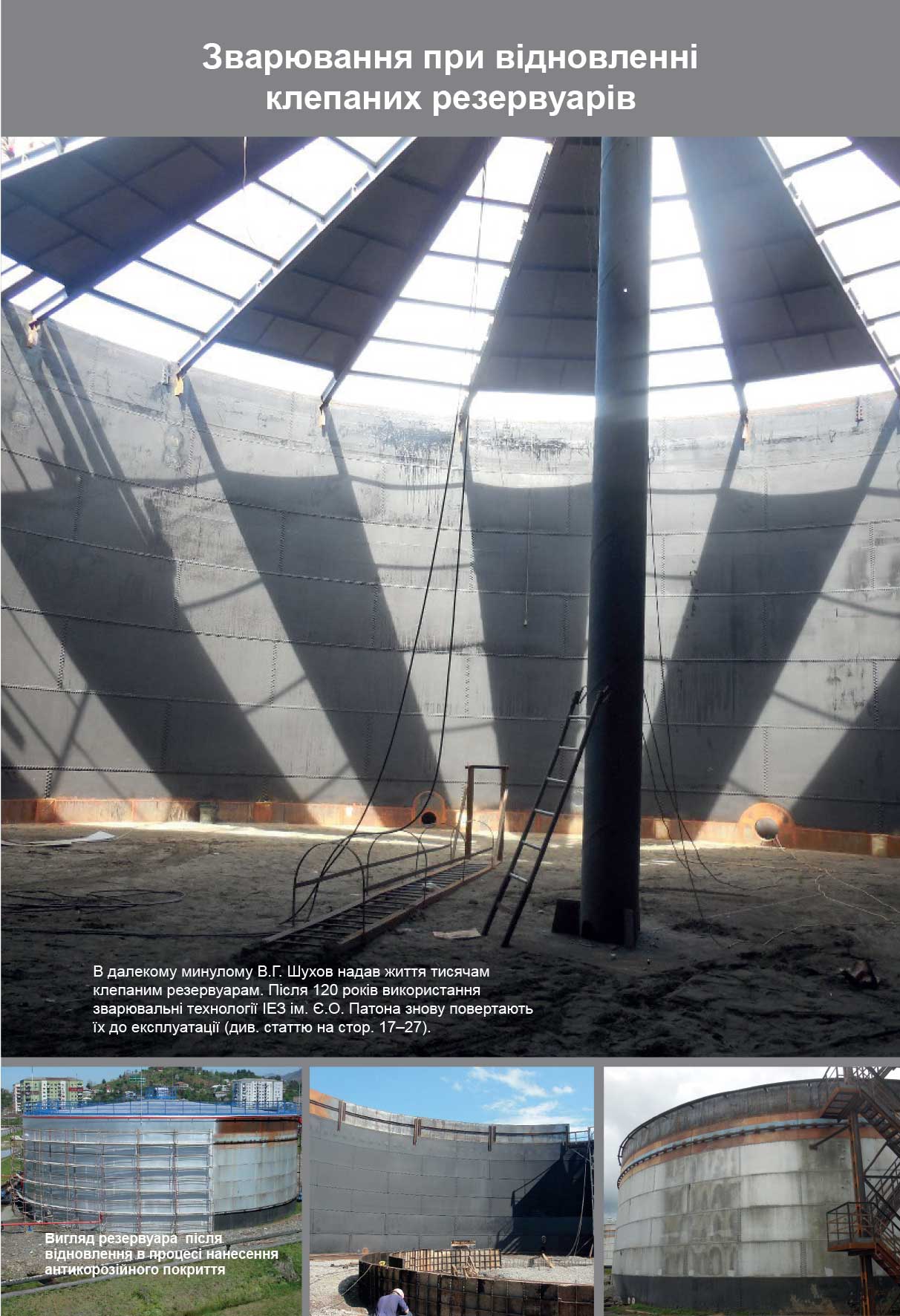
Restoration of riveted cylindrical tanks by using welding
A.Yu. Barvinko , Yu.P. Barvinko, A.M. Yashnyk, O.S. Kostenevych
E.O. Paton Electric Welding Institute of the NAS of Ukraine
11 Kazymyr Malevych Str., 03150, Kyiv, Ukraine.
Е-mail: tanksweld@gmail.com
As a result of the conducted research, it was found that low-carbon steel with content of 0.045-0.05%C and 0.4…0.5Mn was used for the shell of riveted tanks. Taking into account the nitrogen content at the level of 0.003%N and oxygen 0.03%O at a low carbon level, the studied steel may be considered as semikilled. The sulphur content in the steel can reach 0.1%S. However, taking into account that the structure of the base metal and the HAZ is mainly represented by a sufficiently fine-grained ferrite the impact energy of the steel at T = + 15.5 °C (60 °F) satisfies the condition KVmin = 20 J, еmbrittlement of the overheated zone metal is not observed. This indicates the possibility of sufficiently eliminating brittle fracture of welded joints of the specified steel and restoring the riveted tanks using welding. Based on the conducted studies, technical solutions for the complete (partial) replacement of riveted metal structures with welded ones were developed and tested during the repair of tanks after 114 years and 86 years of their operation: bottom, replacement of part of the shell, welding in pipes into the shell and installing a new roof. Successful operation for 10 years with the maximum level of oil product filling of the restored riveted tanks confirmed the correctness of the decisions made. 27 Ref., 7 Tabl., 19 Fig.
Keywords: low carbon steel, weldability, brittle fracture, welded structures, riveted tank, repair
Received: 12.06.2025
Received in revised form: 23.10.2025
Accepted: 27.12.2025
References
1. https://az.wikipedia.org/wiki/Bak%C4%B1_neft-qaz_rayonu [in Azerbaijani]2. https://en.wikipedia.org/wiki/Branobel
3. Yergin, D. (2011) Extraction: A global history of the struggle for oil, money, and power. Transl. from Engl. Moscow, Alpina Publisher [in Russian].
4. http://www.transneft.ru/About/History/[in Russian]
5. (1990) Metal structures of academician V.G. Shukhov. V.P. Mishin (Ed.). Moscow, Nauka [in Russian].
6. Boyd, J.M. (1977) Practical examples of ship structural design. Failure. Vol. 5. Brittle strength analysis of structures. Trans. from Engl. G. Libovets (Ed.). Moscow, Mashinostroyeniye [in Russian].
7. GOST 1497-84. Metals. Tensile test methods (ІSO 6892-84, СТ РЕВ 471-88) [in Russian]
8. GOST 9454-78. Metals. Method of impact bending test at low, room and elevated temperatures [in Russian].
9. GOST 1778-70. Steel. Metallographic methods for the determination of non-metallic inclusions (ISO 4967-79) [in Russian].
10. GOST 5640-68. Steel. Metallographic method for assessing the microstructure of sheets and strips [in Russian].
11. GOST 1050-88. High-quality and high-quality steel. Rolled and shaped products, calibrated steel [in Russian].
12. GOST 380-60. Carbon steel of ordinary quality. Grades and general technical requirements [in Russian].
13. GOST 5639-82. Steels and alloys. Methods for detecting and determining grain size. With amendment No. 1 [in Russian].
14. SNiP ІІ В.3-62. Construction norms and rules. Part II, section B. Chapter 3. Steel structures, design standards [in Russian].
15. SNiP 2.01.01-82. Building climatology and geophysics [in Russian].
16. prEN 14015:2004 Specification for the design and manufacture of site built, vertical, cylindrical, flat-bottomed, above ground, welded, steel tanks for the storage of liquids at ambient temperature and above.
17. (2014) API Standart 653 Tank Inspection, Repair, Alteration, and Reconstruction - Fifth edition.
18. MSC.177(79). Code for the construction and equipment of ships carrying liquefied gases in bulk. Chapter 6. Materials of construction.
19. Hirenko, V.S., Dyadin, V.P. (1985) Dependence between impact toughness and fracture mechanics criteria δ1c, R1c of structural steels and their welded joints. Avatomatycheskaia svarka, 9, 13-20 [in Russian].
20. Shiratori, M., Miyoshi, T., Matsushita, H. (1986) Computational fracture mechanics. Moscow, Mir [in Russian].
21. Broek, D. (1980) Fundamentals of fracture mechanics. Trans. from Engl. Moscow, Vysshaya shkola [in Russian].
22. Barvinko, A.Yu., Barvinko, Yu.P. (2016) On possibility of prevention of avalanche-like fractures of the wall of cylindrical tanks for oil storage by application of sheet steel with increased values of impact toughness. Tekhnycheskaia dyahnostyka i nerazrushaiushchii kontrol, 2, 44-49 [in Russian]. https://doi.org/10.15407/tdnk2016.02.05
23. Knysh, V.V., Barvinko, A.Yu., Barvinko, Yu.P., Yashnik, A.N. (2012) Substantiation of «leak-before-break» criterion for vertical cylindrical tanks for oil storage. The Paton Welding J., 9, 26-29.
24. Bourga, R., Moore, P., Janin, Y.-J., Wang, B., Sharples, J. (2015) Leak-before-break: Global perspectives and procedures. Int. J. of Pressure Vessels and Piping, 129-130, 43-49. https://doi.org/10.1016/j.ijpvp.2015.02.004
25. Goldshtein, M.I., Grachev, S.V., Veksler, Y.G. (1985) Special steels. Moscow, Metallurgy [in Russian].
26. Skorokhodov, V.N., Odessky, P.D., Rudchenko, A.V. (2002) Construction steel. Moscow, Metallurgizdat [in Russian].
27. SNiP 3.03.01-87. Supporting and enclosing structures [in Russian].
This article is licensed under a Creative Commons Attribution Non-Commercial 4.0 International (CC-BY-NC).
Suggested Citation
A.Yu. Barvinko, Yu.P. Barvinko, A.M. Yashnyk, O.S. Kostenevych (2026) Restoration of riveted cylindrical tanks by using welding. Automatic Welding, 01, 17-27. https://doi.org/10.37434/as2026.01.03Advertising in this issue: