

| 2003 №10 (10) | 2003 №10 (12) |

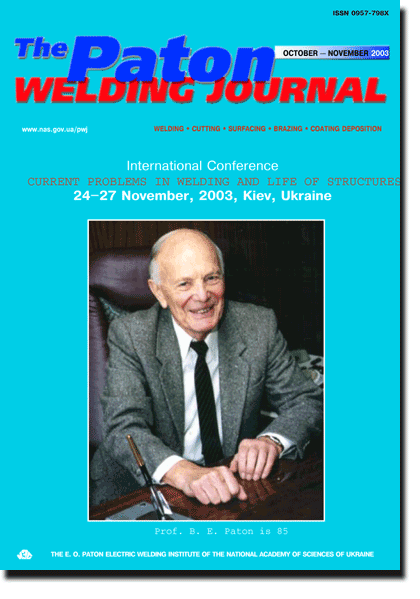
The Paton Welding Journal, 2003, #10-11, 74-78 pages
Preliminary study on penetration mechanism of double-sided GTAW process
H.M. Gao, L. Wu, H. Dong
State Key Laboratory of Advanced Welding Production Technology, Harbin Institute of Technology, ChinaAbstract
How increasing the productivity and lowering the costs are always a serious problem in the welding production. Large amounts of research were done, and many new welding processes were presented, the double-sided arc welding (DSAW) process is one of them. Experiments show that this new process has many advantages in contrast with conventional processes, especially the penetration ability. Up till now, many characteristics of the process are not well known, so deep research into its mechanism is needed, and it is significant for its application. In this paper, through theoretical analysis, experimentation and numerical simulation, the penetration mechanism of double-sided GTAW process is probed. Results show that, firstly, the welding current flows straight through the weld zone, leads to a concentrated current distribution, forms a stronger electromagnetic force field, and causes a stronger fluid flow in the weld pool, which is in favor of the penetration. Secondly, during double-sided GTAW process, when the weld is partially penetrated, there is a heat-concentration zone between the bottoms of the two weld pools, where the temperature can increase quickly even though only a small amount of heat is applied. Thirdly, the buoyancy force caused an inward flow in the bottom weld pool, which can drive the hot liquid on the surface to the bottom of the pool, and then form deep weld pool.
Keywords: double-sided GTAW process, weld penetration, numerical simulation, aluminum alloy
References
1. (1995) Welding handbook. Vol. 1. Welding process and equipment. Chinese Machine Press.2. Chen Yuchuan (1993) New welding techniques development in boiler manufacturing. In: Proc. of 7th Nat. Annual Welding Conf., Qingdao, China, 1993. Vol. 1. 26–36.
3. Zhang, Y.M., Zhang, S.B. (1998) Double-sided arc welding increases weld joint penetration. Welding J., June, 57–61.
4. Zhang, Y.M., Zhang, S.B. (1999) Welding aluminum alloy 6061 with the opposing dual-torch GTAW process. Ibid., June, 202–206.
5. Zhang, Y.M., Pan, C., Male, A.T. (2000) Improved microstructure and properties of 6061 aluminum alloy weldments using a double-sided arc welding process. Metall. and Mater. Transact., 31A, 2537–2543.
6. Gao, H.M. (2001) Research on the mechanism of doublesided arc welding process and the numerical simulation of temperature and fluid flow fields. Dr. Ph. Thesis. Harbin Institute of Technology.
Suggested Citation
H.M. Gao, L. Wu, H. Dong (2003) Preliminary study on penetration mechanism of double-sided GTAW process. The Paton Welding J., 10, 74-78.The cost of subscription/purchase order journals or individual articles
| Journal/Currency | Annual Set | 1 issue printed |
1 issue |
one article |
| TPWJ/USD | 384 $ | 32 $ | 28 $ | 28 $ |
| TPWJ/EUR | 348 € | 29 € | 24 € | 24 € |
| TPWJ/UAH | 7200 UAH | 600 UAH | 600 UAH | 600 UAH |
| TDNK/UAH | 1680 UAH | 420 UAH | free access | free access |
| TDNK/USD | 128 $ | 32 $ | free access | free access |
| TDNK/EUR | 116 € | 29 € | free access | free access |
TPWJ = «PATON WELDING JOURNAL» - 12 issues per year;
TDNK = «Technical Diagnostics and Non-Destructive Testing» - 4 issues per year;
SEM = «Electrometallurgy Today» - 4 issues per year, operates under a diamond open access model, providing free and unrestricted access;
AS = «Automatic Welding» - 6 issues per year, operates under a diamond open access model, providing free and unrestricted access/