


| WRT2025.36 |
DOI: 10.37434/WRT2025.01 |
WRT2025.02 |
Features of increasing penetration in high-frequency pulsed tig welding of carbon and stainless steel (experimental studies)
Dmytro Kovalenko1, Igor Krivtsun1, Alexander Biber2, Oleg Mokrov2, Oleksii Pavlov1
1ІЕЗ ім. Є.О. Патона НАН України. 03150, м. Київ, вул Казимира Малевича, 11.2ISF – Institut für Schweißtechnik und Fügetechnik (Welding and Joining Institute), RWTH Aachen University, Aachen, Germany
The TIG welding process using high-frequency modulation of the welding current is one of the methods for controlling and increasing the penetration of the weld metal. The description of the developed at PWI module of high-frequency modulation of welding current as applied to TIG welding is presented. The module provides independent regulation of the current pulse frequency f in the range of 4–12 kHz, the duty cycle D = tp/T in the range of 0.3–0.7, the maximum pulse current Ip and mean current Imean to values lying in the range of 100–290 A and 50–150 A, respectively. The methodology and results of experimental studies of the characteristics of high-frequency pulsed TIG welding of carbon (S235 in 10 mm thick) and stainless (1.4301/AISI 304 in 5, 6 and 8 mm thick) steels are presented. It is shown that no influence of material and welding frequency on current rising speed visible. Current drop speed for all frequencies identical (function of the current). As the welding frequency increases, the pulse shape changes from trapezoidal to triangular. The module that stores and releases electrical energy, acting like a capacitor. It has been established that the penetration depth depends on the current pulse frequency. In this case, regardless of the type and thickness of the steel, the maximum penetration depth is achieved at a frequency of 6 kHz, which corresponds to an increase in the penetration depth compared to DC welding of up to 40 % for stainless steel in 5 mm thick.
Features of increasing penetration in high-frequency pulsed tig welding of carbon and stainless steel (experimental studies)
Dmytro Kovalenko, Igor Krivtsun, Alexander Biber, Oleg Mokrov, Oleksii Pavlov
Реклама
2026.06.29
Dear readers and authors!
We are delighted to announce that 5 December 2025 Scopus has accepted our application to index monthly “The Paton Welding Journal”.
What is particularly important is that this decision includes retroactive indexing of articles published between 2022 and 2025.
At the same time, we encourage you to submit further manuscripts.
We will be happy to publish your future work, which, thanks to the journal's presence in the Scopus database, will gain global visibility and real impact in the scientific community.
Scientific and practical seminars:
"3D PRINTING OF METAL PRODUCTS"
(May 26, 2026)
and "NON-DESTRUCTIVE TESTING AND TECHNICAL CONDITION MONITORING"
(May 27, 2026)
Starting from 2026.01.03, you can download PDF files of «The Paton Welding Journal» for the year 2024!
2025.12.06
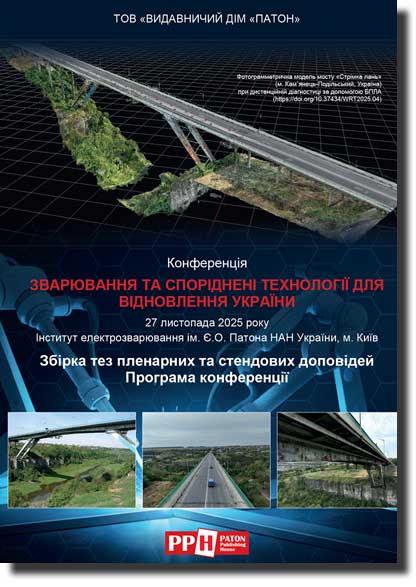
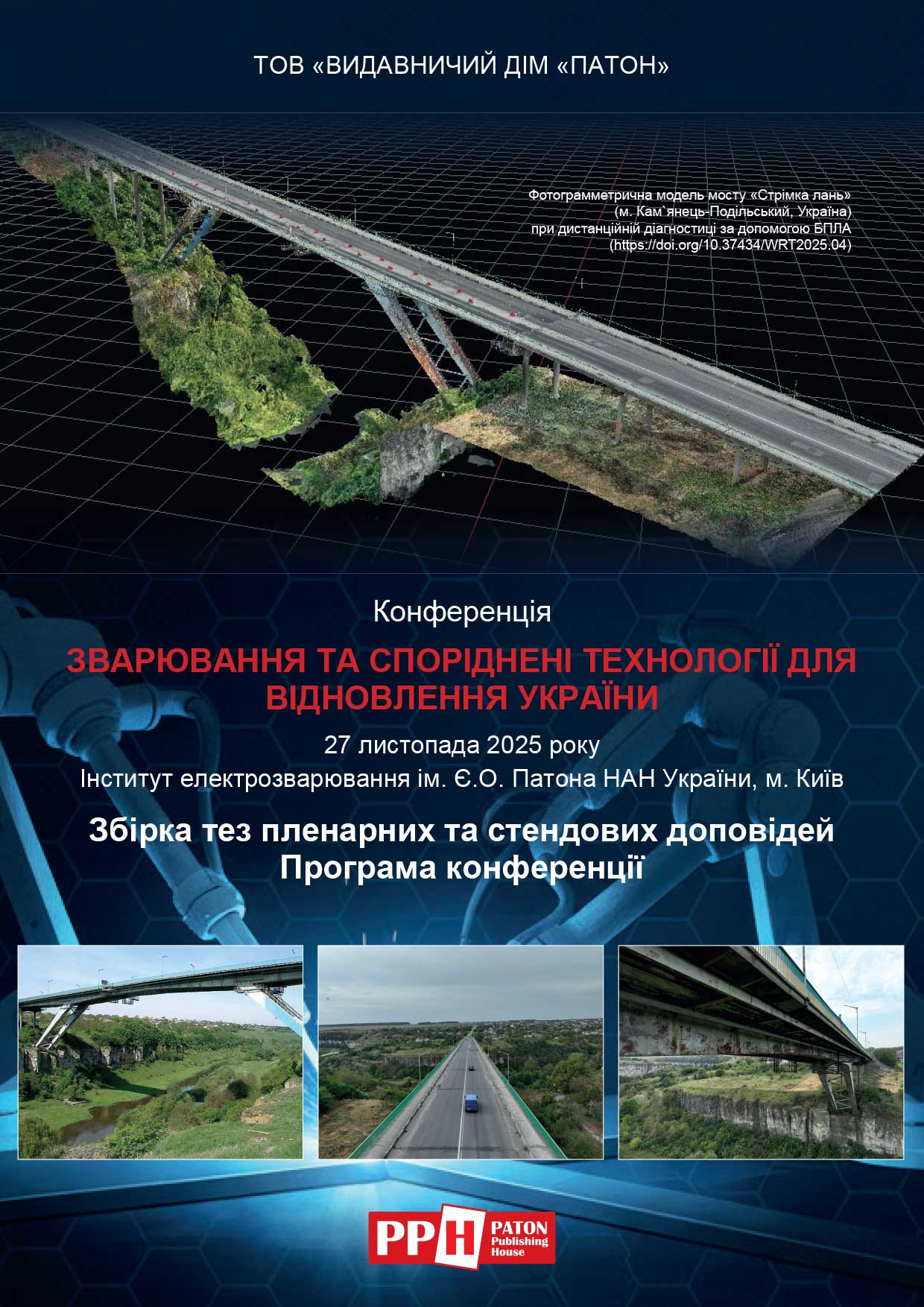
Collection of abstracts of conference Welding and related technologies for the restoration of Ukraine (November 27, 2025, Kyiv)
2025.12.05
We are pleased to announce that on 5 December 2025, Scopus accepted our application for indexing «The Paton Welding Journal». Importantly, this decision includes indexing articles published between 2022 and 2025. We sincerely congratulate us all on this joint achievement and encourage Authors to submit new manuscripts.
2025.06.02
Collection of abstracts of scientific and technical seminars: "3D PRINTING OF METAL PRODUCTS" (May 27, 2025) and "NON-DESTRUCTIVE TESTING AND TECHNICAL CONDITION MONITORING" (May 28, 2025)
Scientific and practical seminars:
"3D PRINTING OF METAL PRODUCTS"
(May 26, 2026)
and "NON-DESTRUCTIVE TESTING AND TECHNICAL CONDITION MONITORING"
(May 27, 2026)
Starting from 2026.01.03, you can download PDF files of «The Paton Welding Journal» for the year 2024!
2025.12.06
Collection of abstracts of conference Welding and related technologies for the restoration of Ukraine (November 27, 2025, Kyiv)
2025.12.05
We are pleased to announce that on 5 December 2025, Scopus accepted our application for indexing «The Paton Welding Journal». Importantly, this decision includes indexing articles published between 2022 and 2025. We sincerely congratulate us all on this joint achievement and encourage Authors to submit new manuscripts.
2025.06.02
Collection of abstracts of scientific and technical seminars: "3D PRINTING OF METAL PRODUCTS" (May 27, 2025) and "NON-DESTRUCTIVE TESTING AND TECHNICAL CONDITION MONITORING" (May 28, 2025)