


| WRT2025.31 |
DOI: 10.37434/WRT2025.32 |
WRT2025.33 |
New capabilities of calculation methods for analyzing the weld metal structure orientation
Olha Shtofel1,2, Viktor Holovko1, Danilo Korolenko1
1ІЕЗ ім. Є.О. Патона НАН України. 03150, м. Київ, вул Казимира Малевича, 11.2National Technical University of Ukraine «Igor Sikorsky Kyiv Polytechnic Institute», Kyiv
Almost all of the most important metal quality indicators are determined by its microstructure. Various metallographic studies are used to analyze the microstructure, which require a lot of time and human resources and depend heavily on the employee qualifications. The microstructure components study determines such quality indicators as the non-metallic inclusionstotal content, the inclusion distribution densityin the size range, the of grain boundaries (crystallites) total length, the dislocations densityat grain boundaries, the ferrite grain density distribution with a shape coefficient, and the structural grain orientation angledensity. This work aim is to analyze the structural components, such as grains (crystallites), misorientation angles distribution at the intergranular boundary. To determine the structural grains orientation angle, the EBSD (Electron back scatter diffraction) method is usually used. This method requires special software and cannot be implemented on optical and electron microscopes commonly used in domestic metallurgical laboratories. In addition, the EBSD method does not allow determining the grain misorientation angles at the intergranular boundary, which is an indicator that has a significant impact on the metalmechanical properties.
Keywords: EBSD, structure, metal, grain, orientation, misorientation, computer analysis, welded joints
Список літератури
1. Koko, A., Tong, V., Wilkinson, A.J., Marrow, T.J. (2023) Aniterative method for reference pattern selection in high-resolution electron back scatter diffraction (HR-EBSD). Ultramicroscopy, 248, 113705. https://doi.org/10.1016/j.ultramic.2023.1137052. ISO. Electronic resource. https://cdn.standards.iteh.ai
3. Atiquzzaman, M. (1992) Multirezolution Hough transform - inefficient method of detecting patterns in images. IEEE Transact. on Pattern Analysis and Machine Intelligence, 14(11), 1090-1095. https://doi.org/10.1109/34.166623
4. Zhuravel, I.M., Maksymovych, V.M. (2018) Quantitative analysis of orientation and elongation of grains on metallographic images using Hough transformations. Scientific Bulletin of UNFU, 28(5), 135-138. https://doi.org/10.15421/40280528
5. Holovko, V., Stofel, O., Korolenko, D. (2025) Fractal analysis method of structural components orientation. International J. of Recent Innovations in Academic Research, 9(2), 130-138. DOI: https://doi.org/10.5281/zenodo.15266778
6. Holovko, V.V., Yermolenko, D.Yu., Stepanyuk, S.M., Zhukov, V.V., Kostin, V.А. (2020) Influence of introduction of refractory particles into welding pool on structure and properties of weld metal. The Paton Welding J., 8, 8-14. https://doi.org/10.37434/tpwj2020.08.01
7. Shtofel, O.O. , Holovko, V.V, Korolenko, D.Yu. (2025) Orientation of crystallites and grains on the weld surface depending on the image quality. Organization of scientific research in modern conditions 2025, usc30-00, Seattle, Washington, USA, pp. 3-8. https://doi.org/10.30888/2709-2267.2025-30-00-011
New capabilities of calculation methods for analyzing the weld metal structure orientation
Olha Shtofel, Viktor Holovko, Danilo Korolenko
Реклама
2026.06.29
Dear readers and authors!
We are delighted to announce that 5 December 2025 Scopus has accepted our application to index monthly “The Paton Welding Journal”.
What is particularly important is that this decision includes retroactive indexing of articles published between 2022 and 2025.
At the same time, we encourage you to submit further manuscripts.
We will be happy to publish your future work, which, thanks to the journal's presence in the Scopus database, will gain global visibility and real impact in the scientific community.
Scientific and practical seminars:
"3D PRINTING OF METAL PRODUCTS"
(May 26, 2026)
and "NON-DESTRUCTIVE TESTING AND TECHNICAL CONDITION MONITORING"
(May 27, 2026)
Starting from 2026.01.03, you can download PDF files of «The Paton Welding Journal» for the year 2024!
2025.12.06
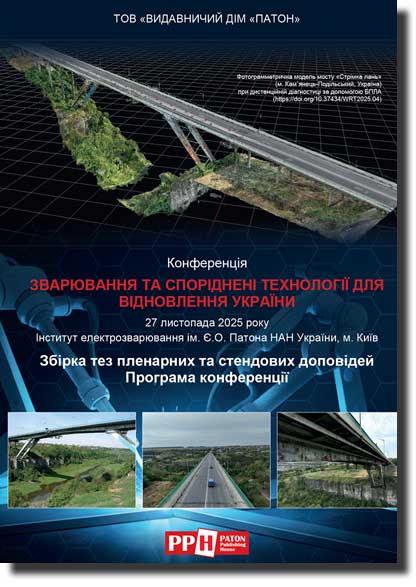
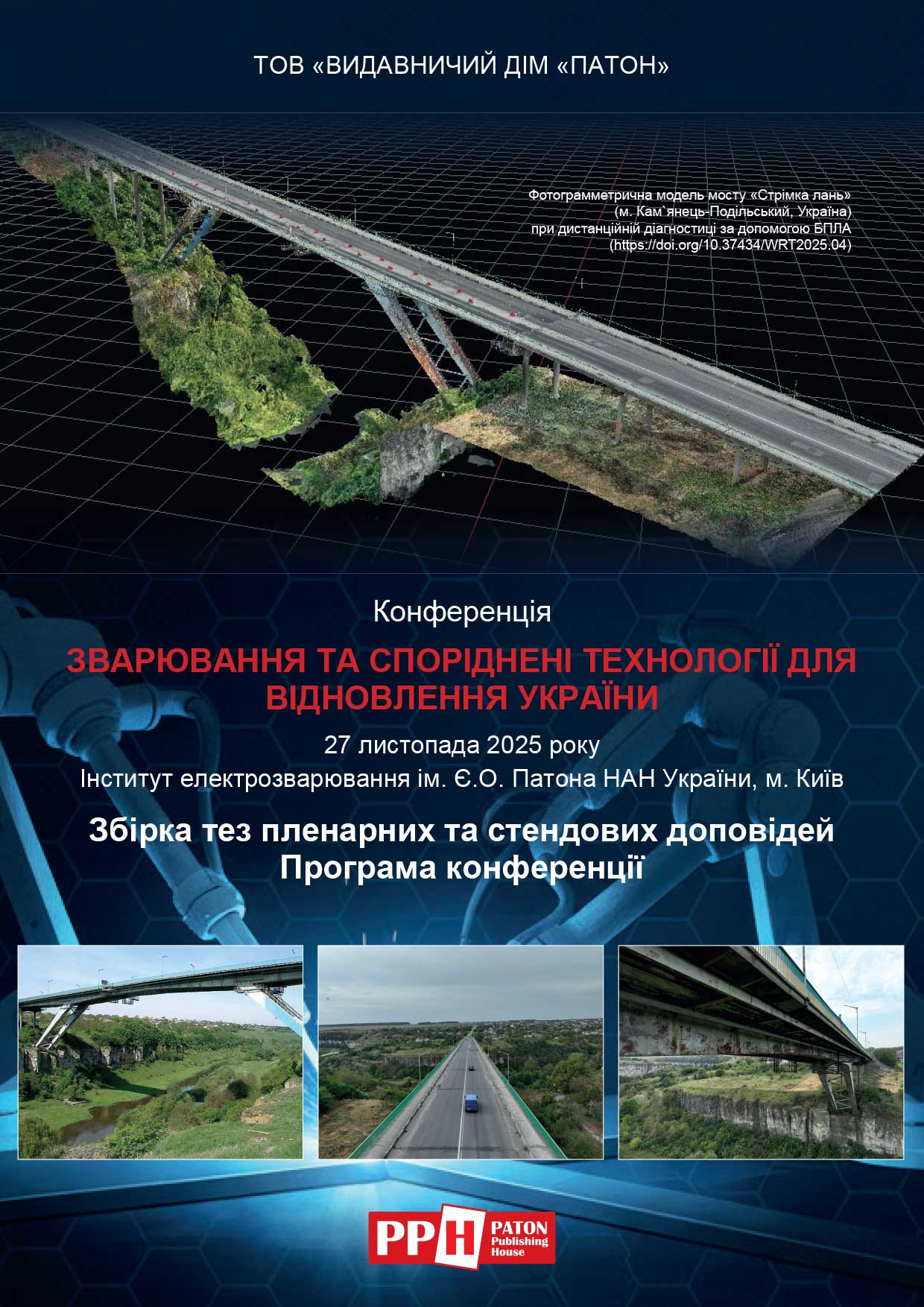
Collection of abstracts of conference Welding and related technologies for the restoration of Ukraine (November 27, 2025, Kyiv)
2025.12.05
We are pleased to announce that on 5 December 2025, Scopus accepted our application for indexing «The Paton Welding Journal». Importantly, this decision includes indexing articles published between 2022 and 2025. We sincerely congratulate us all on this joint achievement and encourage Authors to submit new manuscripts.
2025.06.02
Collection of abstracts of scientific and technical seminars: "3D PRINTING OF METAL PRODUCTS" (May 27, 2025) and "NON-DESTRUCTIVE TESTING AND TECHNICAL CONDITION MONITORING" (May 28, 2025)
Scientific and practical seminars:
"3D PRINTING OF METAL PRODUCTS"
(May 26, 2026)
and "NON-DESTRUCTIVE TESTING AND TECHNICAL CONDITION MONITORING"
(May 27, 2026)
Starting from 2026.01.03, you can download PDF files of «The Paton Welding Journal» for the year 2024!
2025.12.06
Collection of abstracts of conference Welding and related technologies for the restoration of Ukraine (November 27, 2025, Kyiv)
2025.12.05
We are pleased to announce that on 5 December 2025, Scopus accepted our application for indexing «The Paton Welding Journal». Importantly, this decision includes indexing articles published between 2022 and 2025. We sincerely congratulate us all on this joint achievement and encourage Authors to submit new manuscripts.
2025.06.02
Collection of abstracts of scientific and technical seminars: "3D PRINTING OF METAL PRODUCTS" (May 27, 2025) and "NON-DESTRUCTIVE TESTING AND TECHNICAL CONDITION MONITORING" (May 28, 2025)